Prologue
What this site is — and why
"AKTE BAYER" is for lovers and haters of the Werkself alike. History becomes legend, legend becomes myth. And myth becomes cult — or a reason for eternal second-hand embarrassment, depending on the event.
Champions, titles? Aw, man! For decades, Bayer Leverkusen were the eternal runners-up — "Vizekusen" — until Xabi Alonso arrived and delivered the first championship in 2024. The Werkself, bankrolled by the Bayer AG, have experienced it all: the Triple disaster of 2002, Michael Ballack's tears, but also Champions League nights and world-class stars like Völler, Ballack and Havertz. A club caught between corporate image and genuine football madness.
But this site goes beyond mere celebration or hatred. Akte Bayer is structured in three parts: The Club Dossier tells the story — triumphs, tragedies, scandals, heroes and failures across 12 chapters. Match Intelligence delivers the live data a professional needs: squad, statistics, head-to-head, injuries, form. And Predictions brings it all together — with prediction markets.
Prediction markets are not gambling. In traditional sports betting, the masses lose — the money goes to the bookmaker who has built in his margin. Betting exchanges are similar: commissions on winnings, liquidity shortages and spread eat into returns. Prediction markets work fundamentally differently. There is no bookmaker who lets the house win. Instead, money flows from those who don't know to those who get it right — with risk management, portfolio diversification and disciplined capital deployment. You can trade 24/7, build and close positions, and wait for the binary resolution of the event. Those who understand it are not speculating — they're engaged in systematic trading.
Akte Bayer is part of Akte Bundesliga — the same concept for all 18 Bundesliga clubs. Each club gets its own dossier, its own intelligence, its own predictions. The big picture can be found at aktebundesliga.net.
Profile
Facts, figures and milestones
Steckbrief – Facts, figures and milestones
In February 1903, Wilhelm Hauschild wrote a letter to the bosses of Bayer AG. Signed by 170 workers, he requested permission to found a company sports club. The corporation agreed, and on July 1, 1904, the Turn- und Spielverein 1904 der Farbenfabrik, formerly Friedrich Bayer Co. Leverkusen (TUS 04 for short) was established. Its first chairman was a senior Bayer employee — the corporate DNA was embedded from day one.
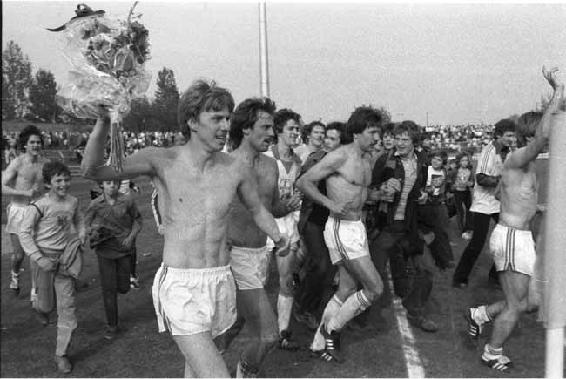
From 1949 to 1975, the club oscillated between various leagues below the professional tier. In the 1974/75 season, Bayer Leverkusen qualified for the promotion play-offs to the 2. Bundesliga. In a group with Arminia Hannover and Union Solingen, the team secured promotion — beginning the slow but steady climb that would eventually lead to the Bundesliga in 1979.
Bayer 04 Leverkusen play their home matches at the BayArena, known as the Ulrich-Haberland-Stadion until its renaming in 1998, with a capacity of 30,120. The fact that Bayer Leverkusen do not violate the "50+1" rule in German football — which prevents a single investor from holding a voting majority — is based on the founding of Bayer 04 Leverkusen Fußball GmbH as a wholly-owned subsidiary of the Bayer AG, predating the rule.
14. Siehe hierzu die Dossiers über den VfL Wolfsburg und RB Leipzig.↩
Good to Know
What few people know
In more than 40 years of Bundesliga membership, Bayer Leverkusen never won the German championship but developed a habit of finishing second — earning the nickname "Vizekusen." That much is known. What fewer people know is that over the past 30 years, Bayer Leverkusen have distinguished themselves through three particular traits in player recruitment.
"Brazilians — com muito gosto": No other club has brought more Brazilian professionals to the Bundesliga than Bayer 04 Leverkusen. It all began in 1987 with the signing of Tita. The midfielder, born Mílton Queiroz da Paixão, was instrumental in Leverkusen's 1988 UEFA Cup triumph. He was followed by future World Cup winners Jorginho, Paulo Sergio and Lucio, among others.
"Super Ossis": Bayer were faster than the competition after the opening of the inner-German border in 1989. Wolfgang Karnath, Bayer stalwart and later player agent for Matthias Sammer, recruited East German superstar Andreas Thom in November 1989 at the World Cup qualifier Austria vs. the GDR (3-0) in Vienna. Thom became the first GDR player in the Bundesliga — a coup that announced Bayer's ambitions.
"Old men": Veteran stars under the Bayer cross. Rudi Völler (1994–1996), Bernd Schuster (1993–1996) and Michael Ballack (2012/13 season) all played in the autumn of their careers for the Werkself. "Everything felt a bit grey, almost loveless," Völler later recalled in 11 FREUNDE, describing his first visit to the Haberland-Stadion on November 15, 1980 with 1860 München.
For the Haters
Embarrassing disasters and major defeats
Heaviest home defeat: Bayer Leverkusen's heaviest home defeat (as of December 2019) came in one of the many Rhineland derbies. On February 14, 1981, Bayer 04 lost 1-5 to Borussia Mönchengladbach. On January 21, 1984, Bayern triumphed by the same score at the Ulrich-Haberland-Stadion. The disastrous 3-6 against Bayern on August 29, 2009 added further humiliation.
Heaviest away defeat: The heaviest away defeat came against Borussia Dortmund — not in the Bundesliga, but in the 2. Bundesliga Nord. In the 1975/76 season, BVB thrashed Bayer 04 Leverkusen 7-0 on matchday 12.
Longest losing streak: The longest losing streak came in the 2002/03 season. The Werkself lost five consecutive matches from matchday 17 to 21.
Most defeats per season: The record for most defeats in a season was set twice. Bayer Leverkusen lost 18 matches both in the 1975/76 second-division season and in the 1981/82 Bundesliga campaign.
Most consecutive matches without a win: This negative record was also set twice. The Farbenstädter went 13 matches without a win both in 1980/81 and in 1995/96.
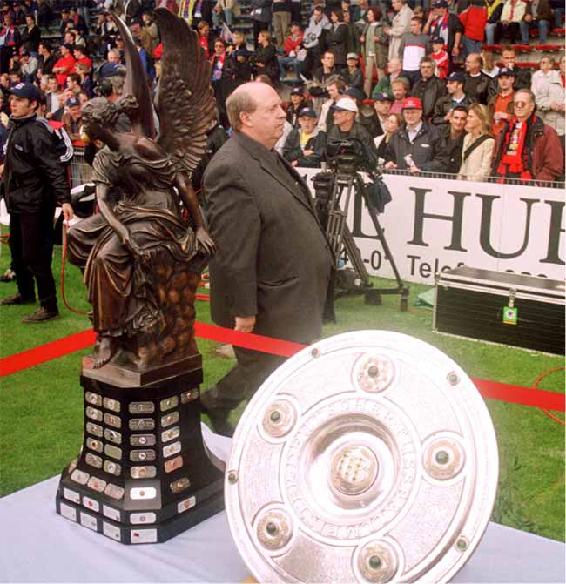
Most embarrassing cup turnaround: The most embarrassing cup turnaround for Bayer 04 was delivered by Michael Ballack and co. in Dresden in 2011. The newly promoted second-division side overturned a 3-0 Leverkusen lead in just 22 minutes to make it 3-3, and three minutes before the end of extra time, the Rudolf-Harbig-Stadion erupted as Dynamo made it 4-3. Leverkusen were humiliated.
Nothing to correct about the biggest international debacle: a 2-10 aggregate in the 2011/12 Champions League round of 16 against FC Barcelona. In a Champions League group stage, the 0-5 against Manchester United on November 27, 2013 represented the heaviest international defeat. In the Bundesliga, the Werkself were never more embarrassingly beaten than the 1-6 at newly promoted Hannover 96.
Five-point lead squandered in two matches: The 2001/02 season saw Bayer Leverkusen effectively crowned champions with three matchdays remaining. Five points clear of Borussia Dortmund — what could go wrong? In short: just about everything. A complacent home performance against Werder Bremen (1-2) with a missed penalty from keeper Hans-Jörg Butt, followed by further dropped points, handed the title to Dortmund.
Unterhaching — Schwarz creates distance: If anyone researches the origin of the term "Vizekusen," they will find answers on May 20, 2000. Three points clear of Bayern but with an inferior goal difference, Bayer Leverkusen went into their final match at newcomers SpVgg Unterhaching. After the 4-1 on matchday 33 against Eintracht Frankfurt, Bayer coach Christoph Daum had cranked up the pressure — only for the team to collapse at the decisive moment.
For the Lovers
Key triumphs and major victories
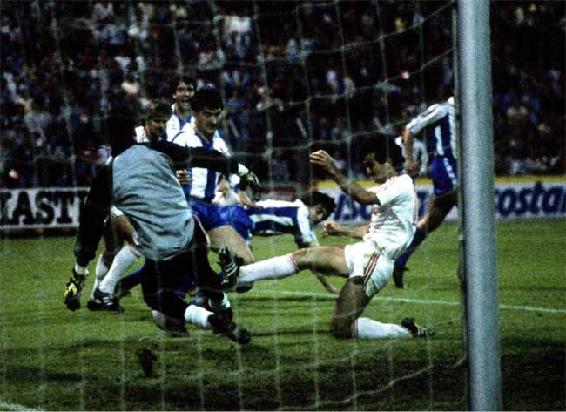
The greatest international success came with the 1988 UEFA Cup triumph: on May 18, 1988, Erich Ribbeck's side beat Espanyol Barcelona in the second leg at the Ulrich-Haberland-Stadion 3-0 after extra time, following a 0-3 first-leg defeat in Spain, then won 3-2 on penalties. All Bayer goals by Tita, Falko Götz and the team — a comeback for the ages.
DFB-Pokal 1993: Domestically, the 1993 cup triumph against Hertha BSC Amateurs (1-0) represents the Werkself's greatest success. Ulf Kirsten, the most prolific Bundesliga scorer of the 1990s with 149 goals, delivered the 1-0 winner in the Berlin final.
Great sympathy: The club often maligned as a "plastic club" from the Rhineland won widespread admiration with their run to the 2002 Champions League final. In the Glasgow final, they fell narrowly to heavy favourites Real Madrid (1-2). "The gala performances in the Champions League season under Klaus Toppmöller will stay with me forever," a fan wrote.
Like a tornado: The 1999/2000 Bundesliga title race in a long-distance duel with Bayern drove Bayer Leverkusen to the highest victory in their Bundesliga history. On March 18, 2000, Christoph Daum's side stormed the Donaustadion and demolished promoted SSV Ulm 9-1 (4-0 at half-time). "They came like a tornado," BILD headlined. No Bundesliga team has scored nine goals since.
Highest home wins: Bayer's biggest home victories came in the 2. Bundesliga. They thrashed Rot-Weiß Lüdenscheid 8-1 in the 1978/79 season, and even more valuably beat "brothers" Bayer 05 Uerdingen 7-0 in the 1977/78 2. Bundesliga Nord.
Carnival at Bayer: Leverkusen is also a Rhineland carnival stronghold — and on February 28, 1995, Shrove Tuesday, the team played themselves into a frenzy with a 5-1 UEFA Cup quarter-final victory over French title contenders FC Nantes at the Haberland-Stadion. "Mr. European Cup" Ulf Kirsten extended his remarkable scoring record that season.
Bayer storm Wembley: In the 2016/17 season, Bayer Leverkusen won in front of their largest-ever international crowd of 85,512 at London's Wembley Stadium. At England's football cathedral, temporary home of Tottenham Hotspur, a Kevin Kampl goal secured the historic 1-0 victory.
Cup records: Bayer Leverkusen's biggest DFB-Pokal victories both came in round one, each featuring eleven goals. In 1994/95 they demolished BSV Stahl Brandenburg 11-0; in 2010/11 FK Pirmasens suffered an 11-1 hammering on their own ground.
Longest winning streak: Bayer 04 won 14 consecutive matches spanning the 1977/78 and 1978/79 seasons — matchdays 34-38 of 1977/78 and matchdays 1-9 of 1978/79.
Most Important Persons
The men who shaped the club
"Don Calli": He essentially "invented" Bayer 04 Leverkusen. The corpulent man from the Erft district devoted nearly 30 years of his life to the works club until his departure in 2004. As youth director, youth coach, stadium announcer and XXL manager, Calmund was the face, soul and architect of everything modern Leverkusen became…
"Der Schwatte" (The Dark One): The striker from Saxony was one of the famous GDR transfers engineered by Bayer legend Wolfgang Karnath. Karnath, known as Calmund's "right hand" with a legendary reputation in the scouting world, brought Kirsten to the Rhineland — where he became the Bundesliga's most prolific scorer of the 1990s…
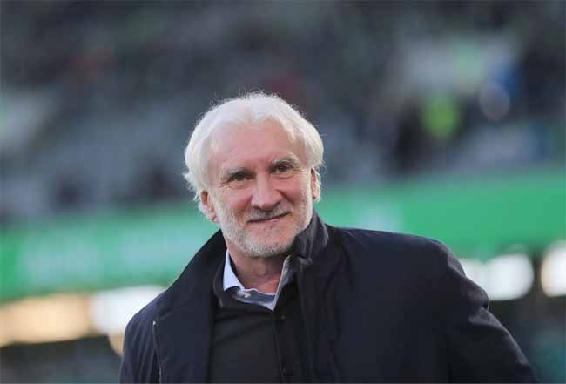
From returnee to Bayer legend: That the globe-trotting world star, who had celebrated triumphs in France and Italy, returned to the Bundesliga at 34 was a sensation and a genuine coup by Bayer mastermind Reiner Calmund. Völler arrived to find a grey, almost loveless atmosphere — and transformed it into something worth caring about…
The record holder: Though the Berlin-born goalkeeper never won a senior cap for Germany, the 1981 U20 World Cup winner became immortal at Bayer. Signed from Blau-Weiß 90 Berlin, Vollborn amassed more appearances for the club than any other player — a monument of consistency and loyalty…
The "Sir": The Rhinelander, whom the tabloids nicknamed "Sir Erich" for his stately manner of expression, arrived at Bayer in 1985. Ribbeck, previously a coaching nomad, led the club to their first major trophy — the 1988 UEFA Cup — in the most dramatic fashion imaginable…
Personae Non Gratae
The men fans love to hate
An incredible meltdown: Being sacked without notice at the "works club" is something few professionals have managed in more than 40 years of Bundesliga football at Bayer Leverkusen. On April 12, 2015, the 94-cap Bosnian international completely lost control — a volcanic eruption that ended his Leverkusen career on the spot…
The unapproachable "General": Hiring the reigning European Championship-winning coach of 1988 seemed a masterstroke for newly installed manager Reiner Calmund. The Dutchman was no stranger to the Rhineland — but his authoritarian methods proved a poor fit for the Bayer culture…
"Schmidteinander" in the stands: The Sauerland native was briefly considered a high-flyer of German coaching when he signed at Bayer 04 Leverkusen in 2014 as reigning Austrian champion (with RB Salzburg). But repeated touchline bans and confrontational behaviour ultimately undermined his tenure…
Scandals paved the career of the bad blond angel: Bernd Schuster began his football career in December 1969 in the youth ranks of SV Hammerschmiede in Augsburg. He moved to FC Augsburg in 1976 and made his international debut in 1978. The "Blond Angel" became a global star at Barcelona before returning to the Bundesliga — where scandal followed him to Leverkusen…
Bayer Leverkusen suspended the Blond Angel. He moved to UNAM Pumas in Mexico City and retired from professional football in 1997.
Tragic
Those who suffered misfortune
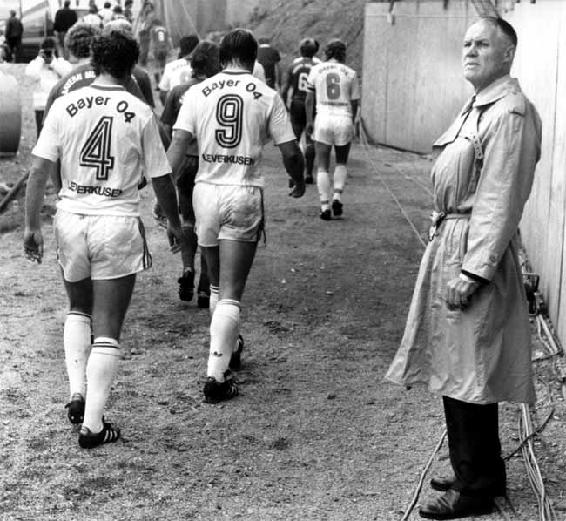
Christoph Daum: Bad luck is getting caught. Stupidity is incriminating yourself. "The sniffling Daum" — that's how Bayern power broker Uli Hoeneß set the ball rolling in October 2000. The suggestion that the Bayer coach had a cocaine habit destroyed Daum's dream of becoming German national team manager — and ended his Leverkusen career in the most spectacular public downfall German football had seen.
Sascha Lewandowski: In June 2016, former Leverkusen Bundesliga coach Sascha Lewandowski took his own life. According to research by the Westdeutsche Allgemeine Zeitung (WAZ), the 44-year-old was under investigation for abuse of a twelve-year-old boy. A tragic end that cast a dark shadow over his coaching legacy.
15. https://www.waz.de/staedte/bochum/sascha-lewandowski-vor-seinem-tod-des-kindesmissbrauchs-verdaechtigt-id11904488.html↩
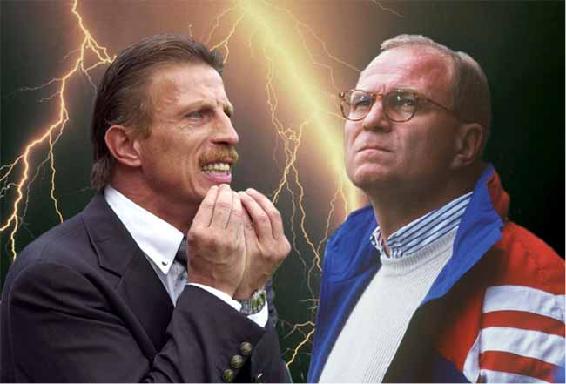
OMG — Oh My God
You can't be serious
Scandals in blond and white: Bayer Leverkusen are "the eternal runners-up," say all those who dislike the works club. "Civil-servant football" is the charge from critics who believe the club underperforms despite the backing of the mighty Bayer corporation. Lack of bite, blandness — perhaps, perhaps not. But one thing the Werkself have never lacked is scandal.
Schuster sues his own club: When Bernd Schuster returned to the Bundesliga from Spain in 1993 to join Bayer 04 Leverkusen, the works club believed they had signed their first world star. The good-natured Bayer coach Dragoslav Stepanović soon found that managing the temperamental genius was another matter entirely. The relationship deteriorated until Schuster took legal action against his own employer.
Phantom goal champions Bayer 04: Twice in their Bundesliga history, Bayer scored goals that quite obviously weren't. Only the referee didn't notice. One was given and brought the scorer shame; the other was disallowed by the scorer himself, earning astonished admiration. In order:
Phantom goal 1: March 7, 1981. There's a whiff of sensation at the Ulrich-Haberland-Stadion. Bayer 04, playing their second Bundesliga season, were demolishing reigning and future champions Bayern München. It was already 3-0 at half-time, all goals by the Norwegian Arne-Larsen Økland. Then in the 72nd minute, something happened that would haunt the scorer forever.
Phantom goal 2: The second phantom goal fell in the Bundesliga's 50th season in the away match at Sinsheim against TSG Hoffenheim. This time the ball was in the net, but shouldn't have been — it gained "unauthorised entry." A hole gaped in the side netting, and through it the ball slipped in the seventh minute, creating one of the most bizarre incidents in Bundesliga history.
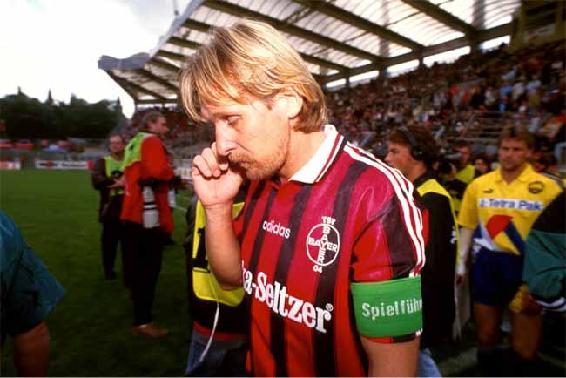
About Schmidt: Bayer Leverkusen have had many coaches with peculiar methods. Christoph Daum made his players walk over broken glass. Heiko Herrlich invoked the "Beppo Principle" of the good street sweeper. Erich Ribbeck conjured disaster in his second stint. And Roger Schmidt? As mentioned, he conjured up confrontation — earning repeated touchline bans that became the defining feature of his tenure.
Fun Facts
Knowledge for blowhards, braggadocios and connoisseurs
Dass Bayer Leverkusen eine „Titel-Allergie“ anhaftet, ist bekannt. Weniger bekannt sind diese Fakten…
"Herbert did it!" Or rather: Herbert Waas, the first German international provided by Bayer 04 Leverkusen. The Passau native made his national team debut on June 7, 1983, aged 19 years, eight months and 30 days — only six months older than Kai Havertz at his debut on September 9, 2018.
Leverkusen can be champions after all: A Bundesliga season with Bayer Leverkusen as champions never happened through 2019/20. But a second-division season did. Bayer finished the 1978/79 campaign as champions of the 2. Bundesliga Nord.
Two World Cup winners on the bench: The turbulent 2000/01 season gave Bayer 04 the rare pleasure of employing two World Cup winners as head coach. Sporting director and national team coach Rudi Völler (1990 World Cup winner), stepping in after Christoph Daum's cocaine own goal, masterfully managed his third hat as caretaker coach.
Table-toppers among non-champions: "Vizekusen" — there's something to it! This stat doesn't help: 70 times Bayer 04 stood at the top of the Bundesliga table (as of December 2019), yet they never finished as champions through 2018/19. The two other non-champions in the Bundesliga's top-10 of table-toppers — Schalke 04 and Eintracht Frankfurt — at least won the title once.
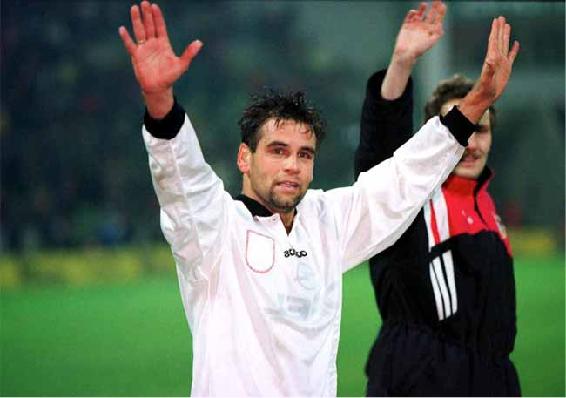
Bayer in first place: This happened for the first time on matchday 3 of the 1986/87 season. That year, only Bayer managed a win over champions Bayern (3-0 in Munich), but it only yielded sixth place.
The Bayern nemesis: Ulf Kirsten scored eleven times against mighty FC Bayern München in 20 Bundesliga matches. Only three players bettered that record during their Bundesliga careers: former Bayer coach Klaus Toppmöller and World Cup runner-up Klaus Fischer (12 goals each) and the Ruhr striker Manfred Burgsmüller, who passed away in May 2019.
The horror year: 2002/03 was a nerve-shredding season that Reiner Calmund "wouldn't wish on his worst enemy." Only on the final matchday did Bayer 04 escape relegation in a direct duel at 1. FC Nürnberg (1-0) — and this in the season after the 2002 "Vice-Triple." Coaches Klaus Toppmöller and Thomas Hörster had to go before club stalwart Thomas Hörster steadied the ship.
Relegation: 16th place in the 1981/82 season meant not only Bayer's worst finish in the top flight, but also a trip to the Bundesliga play-offs. In the inaugural edition of these deciders, Leverkusen prevailed against Kickers Offenbach 1-0 and 2-1 — and stayed up!
Special Moments
"That was my farewell gift to Bayer Leverkusen"
Rudi Völler had a lot on his plate in the hectic days before this May 18, 1996. Constantly on the move — PR appointments here, TV interviews there. The 1990 World Cup winner was organising his farewell match in Leverkusen.
After 19 professional years at Kickers Offenbach, 1860 München, Werder Bremen, AS Roma, Olympique Marseille and Bayer Leverkusen, the 36-year-old wanted to clock off for the final shift at the Ulrich-Haberland-Stadion building site at the end of the season. He was planning a grand farewell gala against the German national team. From summer onwards, he would be working as Bayer's sporting director.
That the football celebrities would come without reservation to the grand farewell on May 21, 1996 was a given. The DFB squad, shortly before EURO 1996 in England, turned up with Fredi Bobic, Mario Basler, Jürgen Klinsmann and co. — the full ensemble. "Rudi's Team" featured Giuseppe Giannini, Ruggerio Rizzitelli and World Cup-winning teammates from the 1990 squad.
But first, Rudi Völler had a small problem to solve with Bayer 04… "Farewell with relegation — that couldn't happen," he summarised the dilemma in 2003. Because in his final match as a professional footballer, the 1993 Champions League winner (with Marseille) could still be relegated. Bayer Leverkusen vs. 1. FC Kaiserslautern — a World Cup winners' duel on the final day.
Despite this misjudgement, the Palatinate side still held the cards. An FCK victory in Leverkusen and they could send the Bayer club down after 27 years in the top flight. All of football Germany seemed to side with the visitors from Kaiserslautern, for whom the "Bundesliga dinosaur" tag — 33 years of unbroken membership — carried emotional weight.
The rather unloved Bayer players, who had never finished higher than fifth, would barely be missed. At least not after this season. Bernd Schuster had sued the club and drove demonstratively into his old player parking space in a black coupé minutes before kick-off of the decisive match — right in front of the stadium entrance.
The opposition seemed to have grasped what was at stake on this rainy Saturday in the Rhineland. "The people in the city, they're trembling with the FCK," said World Cup winner Andreas Brehme with his Hamburg idiom and characteristically creative interpretation of German grammar on SAT.1 weeks before — "that's why we have to deliver."
That's roughly how it ended. The Kaiserslautern players lay on the pitch after the final whistle, shaken by convulsive weeping. They had pushed the "plastic club" to the brink of relegation — and were ultimately dragged down themselves. "We were clearly better," Andy Brehme reflected later. "Our 1-0 through Kuka, then more chances. But eight minutes later it was level — and then everything fell apart."
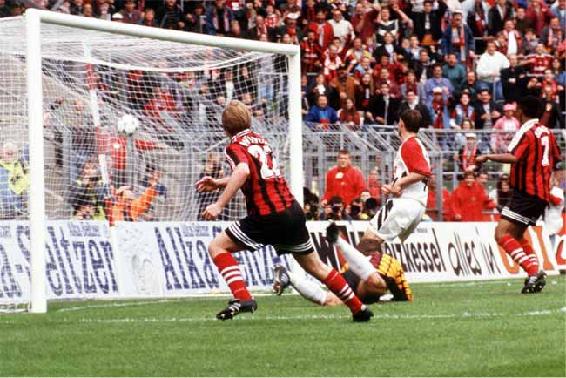
At the 0-1, the Leverkusen players formed a guard of honour, letting Uwe Wegmann stroll through central midfield. He could pass the ball calmly to Frank Greiner on the right, who delivered a pinpoint cross for Pavel Kuka. The Czech headed in completely unmarked from six metres, his marker Markus Münch standing an estimated ten metres away. A catastrophic defensive lapse.
Of all people, Münch — the Palatinate native who would return to FC Bayern München after this catastrophic season — initiated the turnaround for the shell-shocked Bayer side. He fouled Marschall in midfield. Referee Bernd Heynemann (Magdeburg) awarded the free kick but, sensing time-wasting ten minutes from the end, did not stop play. In the ensuing chaos, Leverkusen equalised.
In that moment, it was clear: Bayer Leverkusen would remain in the top flight; Kaiserslautern would go down. The scenes on the Leverkusen side were no less emotional than those among the devastated Kaiserslautern players. Rudi Völler had to support the completely exhausted Dirk Heinen on the way to the dressing room, and in the TV studio had to console his World Cup teammate Andreas Brehme.
How true: with the arrival of coach Christoph Daum on July 1, 1996, a new era began in Leverkusen. Immediately, the widely unloved works club became German runners-up, playing Champions League football for the first time in 1997/98. In 1999 and 2000, only Bayern finished above Daum's side in the final table.
Wise Words
Quotes for eternity
„Wir sind nur die Underducks."
Reiner Calmund, XXL-Manager bei Bayer Leverkusen"At our club, every player can wear a Rolex, drive a Ferrari and wear Gucci underwear. But when he gets changed and plays, he has to eat dirt."
Reiner Calmund, former managing director of Bayer 04 Leverkusen"I've got a lot on the tip of my tongue these days, but now I think before I speak."
Christoph Daum as Bayer Leverkusen coach„Lieber eine Nase voll Koks als Berti Vogts.“ Unbekannter Fan zur Verpflichtung von Berti Vogts als Trainer von Bayer Leverkusen
„Calmund wird zu einem Problem"
Bernd Schuster