Special Moments
Rudi Völler had a lot on his plate in the hectic days before this May 18, 1996. Constantly on the move — PR appointments here, TV interviews there. The 1990 World Cup winner was organising his farewell match in Leverkusen.
After 19 professional years at Kickers Offenbach, 1860 München, Werder Bremen, AS Roma, Olympique Marseille and Bayer Leverkusen, the 36-year-old wanted to clock off for the final shift at the Ulrich-Haberland-Stadion building site at the end of the season. He was planning a grand farewell gala against the German national team. From summer onwards, he would be working as Bayer's sporting director.
That the football celebrities would come without reservation to the grand farewell on May 21, 1996 was a given. The DFB squad, shortly before EURO 1996 in England, turned up with Fredi Bobic, Mario Basler, Jürgen Klinsmann and co. — the full ensemble. "Rudi's Team" featured Giuseppe Giannini, Ruggerio Rizzitelli and World Cup-winning teammates from the 1990 squad.
But first, Rudi Völler had a small problem to solve with Bayer 04… "Farewell with relegation — that couldn't happen," he summarised the dilemma in 2003. Because in his final match as a professional footballer, the 1993 Champions League winner (with Marseille) could still be relegated. Bayer Leverkusen vs. 1. FC Kaiserslautern — a World Cup winners' duel on the final day.
Despite this misjudgement, the Palatinate side still held the cards. An FCK victory in Leverkusen and they could send the Bayer club down after 27 years in the top flight. All of football Germany seemed to side with the visitors from Kaiserslautern, for whom the "Bundesliga dinosaur" tag — 33 years of unbroken membership — carried emotional weight.
The rather unloved Bayer players, who had never finished higher than fifth, would barely be missed. At least not after this season. Bernd Schuster had sued the club and drove demonstratively into his old player parking space in a black coupé minutes before kick-off of the decisive match — right in front of the stadium entrance.
The opposition seemed to have grasped what was at stake on this rainy Saturday in the Rhineland. "The people in the city, they're trembling with the FCK," said World Cup winner Andreas Brehme with his Hamburg idiom and characteristically creative interpretation of German grammar on SAT.1 weeks before — "that's why we have to deliver."
That's roughly how it ended. The Kaiserslautern players lay on the pitch after the final whistle, shaken by convulsive weeping. They had pushed the "plastic club" to the brink of relegation — and were ultimately dragged down themselves. "We were clearly better," Andy Brehme reflected later. "Our 1-0 through Kuka, then more chances. But eight minutes later it was level — and then everything fell apart."
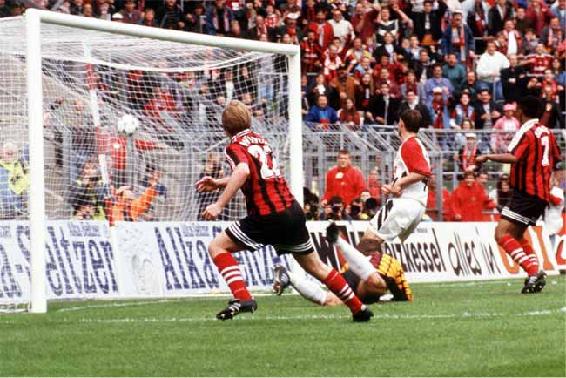
At the 0-1, the Leverkusen players formed a guard of honour, letting Uwe Wegmann stroll through central midfield. He could pass the ball calmly to Frank Greiner on the right, who delivered a pinpoint cross for Pavel Kuka. The Czech headed in completely unmarked from six metres, his marker Markus Münch standing an estimated ten metres away. A catastrophic defensive lapse.
Of all people, Münch — the Palatinate native who would return to FC Bayern München after this catastrophic season — initiated the turnaround for the shell-shocked Bayer side. He fouled Marschall in midfield. Referee Bernd Heynemann (Magdeburg) awarded the free kick but, sensing time-wasting ten minutes from the end, did not stop play. In the ensuing chaos, Leverkusen equalised.
In that moment, it was clear: Bayer Leverkusen would remain in the top flight; Kaiserslautern would go down. The scenes on the Leverkusen side were no less emotional than those among the devastated Kaiserslautern players. Rudi Völler had to support the completely exhausted Dirk Heinen on the way to the dressing room, and in the TV studio had to console his World Cup teammate Andreas Brehme.
How true: with the arrival of coach Christoph Daum on July 1, 1996, a new era began in Leverkusen. Immediately, the widely unloved works club became German runners-up, playing Champions League football for the first time in 1997/98. In 1999 and 2000, only Bayern finished above Daum's side in the final table.